Q1. How does light enable us to see an object?
Solution
An object reflects light falling on it. The reflected light, when received by our eyes enables us to see that object.
Q2. What is the difference between a concave and convex lens?
Solution
A convex lens is thicker at the centre but thinner at the edges whereas a concave lens is thinner in the middle but thicker at the edges.
Q3. Which mirrors are used as side mirrors in scooters? Give reason.
Solution
Convex mirrors are used as side mirrors in scooters because convex mirrors can form images of objects spread over a large area. This helps the drivers to see traffic behind them.
Q4. (a) Why concave mirrors are used as reflectors?
(b) Which color light bends the most and which the least while passing through a prism?
Solution
(a) The concave mirrors are used as reflectors because when lighted bulb is placed at the focus of concave reflector it produces powerful beam of light rays which helps us to see things up to a considerable distance in the darkness of night.
(b) Violet light bends the most and red light bends the least while passing through a prism.
Q5. What are the uses of convex lenses?
Solution
(i) Convex lenses are used as magnifying glass.
(ii) Convex lenses are used in making spectacles, cameras, microscopes, telescopes etc.
Q6. Name some objects which emit light.
Solution
Torch, lighthouse, sun, a lighted candle and tube light.
Q7. How can you say that a concave mirror forms the real image of the sun?
Solution
Take a concave mirror, hold it facing the sun. Try to get the light reflected by mirror on a sheet of paper. Adjust the distance of the paper unless you get bright spot on it. As this image is formed on a screen the image is called as real image.
Q8. Which mirror always produces a virtual, erect and diminished image of an object?
Solution
Convex mirrors always produce a virtual, erect and diminished image of an object.
Q9. What is dispersion of light?
Solution
Dispersion of light is the splitting of light into its component colors on passing through a dispersive medium e.g. prism.
Q10. Which part of spoon acts like a convex mirror?
Solution
The outer part of the spoon acts like a convex mirror.
Q11. Define convex mirror.
Solution
A convex mirror is that spherical mirror in which the reflection of light takes place at the convex surface or bulging-out surface.
Q12. Why concave mirrors are used as shaving mirrors?
Solution
The concave mirrors are used as shaving mirrors because when the face is held within the focus of concave mirror then an enlarged image of the face is seen in the concave mirror.
Q13. What is a lens? Name two types of lenses.
Solution
A lens is a piece of transparent glass bound by two spherical surfaces. The two types of lenses are convex lens and concave lens.
Q14. When is a rainbow observed in the sky?
Solution
A rainbow is seen in the sky usually after the rain when the sun is low in the sky.
Q15. What is a spectrum?
Solution
The band of the coloured components of a light beam formed due to dispersion is called its spectrum.
Q16. What is a spherical mirror? How can you identify that the mirror is concave?
Solution
A spherical mirror is that mirror whose reflecting surface is a part of a hollow sphere of glass. In a concave mirror, the reflecting surface is the bent-in surface.
Q17. Define opaque objects. Give two examples of it.
Solution
An object which does not allow light to pass through it is called an opaque object. E.g., a book, a wooden table etc.
Q18. Which part of the spoon acts like a concave mirror?
Solution
The inner surface of a spoon acts like a concave mirror.
Q19. 'Light has a dual nature'. Comment.
Solution
Light has a dual nature as it exhibits the properties of both waves and particles depending on the situation.
Q20. Why concave mirrors are used by dentists?
Solution
The concave mirrors are used by dentists because when the tooth is within the focus of concave mirror then an enlarged image of the tooth is seen in the concave mirror.
Q21. Which color light bends the most and which the least while passing through a prism?
Solution
Violet light bends the most and red light bends the least while passing through a prism.
Q22. What happens when a beam of light strikes a mirror?
Solution
On striking a mirror, the beam of light changes its direction.
Q23. What is a ray of light?
Solution
A light ray is a very narrow beam of light that moves in definite direction from the source.
Q24. What is the difference between the real image and a virtual image?
Solution
An image which can be obtained on a screen is called a real image, while an image which cannot be obtained on a screen is called a virtual image.
Q25. Which lens is called as diverging lens and why?
Solution
A concave lens is called as diverging lens because it diverges or bends outward the light falling on it.
Q26. Mention any three uses of plane mirrors.
Solution
(i) These are used in making periscopes. (ii) These mirrors are used as looking glass. (iii) These are fixed on the walls of certain shops to make the shops look bigger.
Q27. What kind of image can never be obtained from a convex mirror?
Solution
We can never get a real, inverted and magnified image of with a convex mirror.
Q28. What is an image?
Solution
An image is an optical appearance produced when light rays coming from an object are reflected from a mirror.
Q29. What type of image is formed on the shiny surface of the bell of a new bicycle?
Solution
The image formed is erect and smaller in size.
Q30. What are the uses of lenses?
Solution
Lenses are used to rectify visual defects of vision. Lenses are used in various optical instruments e.g. microscope, photographic camera, projector etc.
Q31. What is Newton's disc?
Solution
When a small circular disc with seven rainbow colours painted on it, is rotated fast, the colors get mixed together and the disc appears to be white. Such a disc is popularly known as Newton's disc.
Q32. What is light?
Solution
Light is a form of energy which is needed to see things around us.
Q33. Why do different colours of light refract at different angles in the formation of a spectrum?
Solution
Each colour of white light travels at a different speed in glass. This results in different colours of light being refracted at different angles.
Q34. Give an activity to show that light travels in a straight line.
Solution
(i) Take a lighted candle and place it on a table.
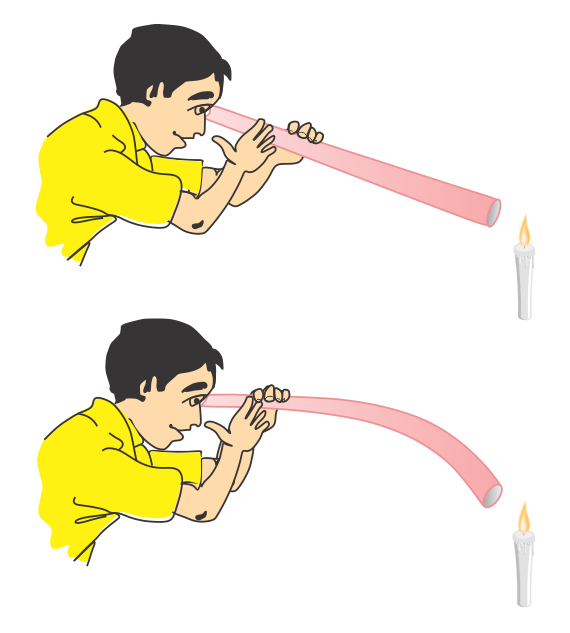 (ii) Look on it through a straight pipe and than through a bent pipe. (iii) You will find that the light can be observed through a straight pipe. This shows that light travels in a straight line.
(ii) Look on it through a straight pipe and than through a bent pipe. (iii) You will find that the light can be observed through a straight pipe. This shows that light travels in a straight line.
Q35. Mention any three uses of concave mirror.
Solution
(i) They are used as reflectors in torches, vehicles head lights, search lights etc. (ii) They are used as shaving mirrors. (iii) They are used by dentist to see the enlarged images of the teeth.
Q36. What is the difference between a virtual image of an object formed by a convex lens and that formed by a concave lens?
Solution
Virtual image formed by a convex lens is always magnified but that formed by a concave lens is always diminished.
Q37. What happens when light falls on a mirror? What is this phenomenon called?
Solution
When light falls on a mirror, it changes the direction of light. This phenomenon is called the reflection of light.
Q38. How can the direction of light be changed?
Solution
The direction of light can be changed when it falls on a polished or shiny surface.
Q39. How does light travel?
Solution
Light travels in straight lines.
Q40. Give one similarity and one difference between a plane mirror and a convex mirror.
Solution
Similarity: Both, plane mirror and convex mirror, form a virtual and erect image of an object.
Difference: In a plane mirror, the image is of the same size as the object but in a convex mirror the image is always smaller than the object.
Comments
Post a Comment