Q1. Two boys ran in a race of 10 km. First boy ran with a constant speed 2 km/h for the whole race, while the second boy ran at 1 km/h for half of the race and at 5 km/h for the other half. Who won the race?
Solution
Total time taken by first boy = 10/2 = 5 h. Total time taken by second boy = (5/1) + (5/5) = 5 + 1 = 6 h. Thus first boy won the race.
Q2. Represent the following motion by a graph
Velocity m s-1
40
30
20
10
Time second
1
2
3
4
Find the acceleration from the graph and
Find the time taken to travel a distance of 35 m from the graph.
Solution
 1. Acceleration is the slope of v-t graph.
 2. t = 1.5 sec for travelling a distance of 35 m.
Q3. What is the definition of time? What is its necessity?
Solution
Time is a moment or duration in which things occur. The knowledge of time is essential for carrying on our daily life activities. For example, our school starts at a particular 'time'. We use our wrist watch to know the time so that we may reach the school on time.
Q4. Name some of the instruments used in earlier times to measure time.
Solution
Some of the instruments used in earlier times to measure time are sundial, waterglass, and hourglass.
Q5. 1 cm on distance axis shows 1 m. How many cms axis do we need to show 10 km?
Solution
Given: 1 cm = 1 m and, 1 km = 1000 m thus, 1 km = 1000 cm (as per our selected axis) Therefore, 10 km = 10 x 1000 cm = 10,000 cm. Thus we need a 10,000 cm. long axis.
Q6. Which of the two is moving faster (a) A car going over a distance of 100 km in 5 hours, or (b) A train covering a distance of 300 km in 6 hours?
Solution
Speed of the car = 100/5 = 20 km/h. Speed of the train = 300/6 = 50 km/h. Hence train is moving faster than the car.
Q7. (a) Out of a line graph, a pie chart and a bar graph which one is the most suitable to show:
1. Runs scored in various overs of a cricket match?
2. Variation of distance covered by a car with time?
3. Percentage composition of air?
(b) State two advantages of drawing distance-time graphs for moving objects.
Solution
(a) 1. Bar graph
2. Line graph
3. Pie chart
(b) Advantages of drawing distance-time graphs:
1. The variation of distance travelled by an object with time can be seen more easily from a distance-time graph than from the distance and time values given in the table form.
2. From a distance-time graph, we can find the distance moved by an object at any point of time.
Q8. How much time does the bob of a second's pendulum take to move from one extreme to the other extreme of its oscillation?
Solution
Time period of a second's pendulum = 2 s
Time taken to complete half oscillation, i.e. from one extreme to the other extreme = 1 s.
Q9. Name one of the biggest pendulum clocks in the world. Where is it located? How long is its pendulum and what is its time period?
Solution
One of the biggest pendulum clocks in the world is the Big Ben at the House of Parliament in London, U.K. Its pendulum is 4 meters long and it takes only 4 seconds to complete one to n fro oscillation or swing.
Q10. 1 cm on time axis on a distance-time graph denotes 1 hour. What is the time taken by a car whose graph shows reading 4.5 cm to cover a particular distance?
Solution
1 cm = 1 hour Therefore, 4.5 cm = 4.5 x 1 = 4.5 hour i.e., 4.5 hour = 4 hour + (1/2) hour = 4 hour 30 minutes.
Q11. What are the common units used to measure time?
Solution
Common units to measure time are second, minute, hour, day, week, and year.
Q12. (i) Why do we need to measure time?(ii) A dog runs behind you for 30 minutes and the distance covered by the dog is 3 km. What should be your minimum speed if dog was not able to bite you?
Solution
(i) We need to measure time in order to keep track of our day to day activities. For eg. Meeting with the doctor, Attending our class at time etc. (ii) Your speed should be greater than that of the dog. Thus we will find speed of the dog and will come to know the minimum of your speed. Speed = Distance covered / Time taken = 3 / 30 = 1/10 km/min. Therefore, Speed = (1/10) x (1000/3600) = 1/36 m/s. Thus you must run at least above the speed of (1/36) m/s.
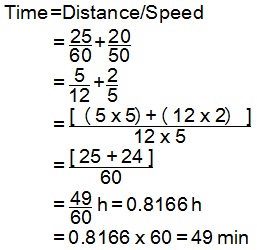
Q13. A bike moves with a speed of 60 km/h and covers 25 km. and then with a speed of 50 km/h covers 20 km to reach the destination. What is the total time taken by the bike is to reach the destination?
Solution
Q14. Which of the units – cm/sec, m/sec, km/h – would you use for the speed of the following?
(a) A car running on a road.
(b) An ant going along a straight line.
(c) The speed of a ball bowled by a bowler.
(d) The speed of a coin on a carom board.
Solution
(a) A car running on a road - km/h.
(b) An ant going along a straight line - cm/sec.
(c) The speed of a ball bowled by a bower - km/h.
(d) The speed of a coin on a carom board - m/sec.
Q15. (i) Give two examples of periodicity observed in nature?(ii) A bike moves with a speed of 60 km/h and covers 25 km. and then with a speed of 50 km/h covers 20 km to reach the destination. What is the total time taken by the bike is to reach the destination?
Solution
(i) Example 1 Revolution of earth around the sun causes the change in season on a periodic basis. Example 2 Rotation of earth around its own axis causes days and nights periodically. (ii)
Q16. It takes 0.2 s for a pendulum bob to move from the mean position to one end. What is the time period of the pendulum?
Solution
 Given that the bob takes 0.2 s to move from the mean position to one end.
That is, say it takes 0.2 s to move from A to C.
We know that 1 complete oscillation is from A-C-A-B-A.
Thus, it takes (4 × 0.2) s to complete one oscillation.
Time period = Time taken to complete 1 oscillation
= (4 × 0.2) s
= 0.8 s
Given that the bob takes 0.2 s to move from the mean position to one end.
That is, say it takes 0.2 s to move from A to C.
We know that 1 complete oscillation is from A-C-A-B-A.
Thus, it takes (4 × 0.2) s to complete one oscillation.
Time period = Time taken to complete 1 oscillation
= (4 × 0.2) s
= 0.8 s
Q17. Why do we take average speed into consideration while calculating distance covered or time taken?
Solution
We take average speed into consideration because during its journey an object may undergo change in speed, sometimes its speed may increase and sometimes it may decrease. Thus to include the changes and to simplify calculations we assume speed to be the average of the fluctuations happened.
Q18. Calculate the time period of pendulum which oscillates 100 times in an hour.
Solution
Total time taken = 1 hour = 60 minutes = 3600 seconds Total no. of oscillations = 100 Therefore, Time Period of the pendulum = 3600/100 = 36 seconds
Q19. Name the device that is used to check the speed of a vehicle?
Solution
Speedometer.
Q20. Explain Periodic motion and give examples of the same.
Solution
Periodic motion: When a moving object passes through a certain point at regular intervals of time, its motion is called periodic motion. Motion of the Earth around the Sun and the movement of trapeze artists in a circus are examples of periodic motion. In periodic motion, one round is completed in the same time, every time.
The following are some examples of periodic motion:
Motion of the hands of a clock
Motion of the Earth around the Sun
Q21. Define time period as related to a simple pendulum.
Solution
Time period is defined as the time taken to complete one oscillation. It is measured in second (s).
Q22.
The time interval obtained by dividing a minute into 60 equal parts is the basic unit of time. What is it known as?
How many seconds make a day (one solar day)?
Solution
Q23. Kalpesh, before going out, takes the reading of odometer of his motorcycle. It was 8,245 km. Driving at uniform velocity of 60 km/h for 30 min on a straight highway; he reaches his friend’s village. What would be the odometer reading of his motorcycle there?
Solution

Q24. If one wants to change the time period of a pendulum, what should be done to do so?
Solution
As the time period of a pendulum depends on its length, thus one should change the length of the pendulum to change its time period.
Q25. (i) Which of the two is a bigger unit of time: microsecond or nanosecond?(ii) Give three daily life examples of non-uniform motion.
Solution
(i) 1 microsecond = 10-6 second 1 nanosecond = 10-9 second So, a microsecond is a bigger unit of time than nanosecond. (ii) Examples: (a) A vehicle moving on a road which keeps on changing its speed. (b) A ball rolled on a rough surface. (c) A bird flying randomly into the sky.
Q26. A train travels at a speed of 180 km/h. How far will it travel in 4 hours?
Solution
Given:
Speed of the train = 180 km/h
Time of travel = 4 hours
Distance = ?

Q27. During an experiment, a signal from a spaceship reached the ground station in five minutes. What was the distance of the spaceship from the ground station? The signal travels at the speed of light, that is, 3 × 10⁸ ms-1.
Solution
Given that, Speed = 3 × 10⁸ m/s
Time taken = 5 × 60 s = 300 s
We know that Distance = Speed × Time
= 3 × 10⁸ m/s × 300 s
→Distance = 900 × 108 m = 9 ×10¹¹ m
Q28. A dog runs behind you for 30 minutes and the distance covered by the dog is 3 km. What should be your minimum speed if dog was not able to bite you?
Solution
Your speed should be greater than that of the dog. Thus we will find speed of the dog and will come to know the minimum of your speed. Speed = Distance covered / Time taken = 3 / 30 = 1/10 km/min. Therefore, Speed = (1/10) x (1000/3600) = 1/36 m/s. Thus you must run at least above the speed of (1/36) m/s.
Q29. What is the unit of time period?
Solution
Unit of time period is same as the unit of time. For example second, minute, hour etc.
Q30. The distance between two stations is 560 km. A train takes 480 minutes to cover this distance. Calculate the speed of the train.
Solution
Distance = 560 km Time taken = 480 min = 480/60 = 8 hours So, Speed of train = distance travelled/time taken = 560 km/8 h = 70 km/h.
Comments
Post a Comment